
Fayette County Court Records After a Jail Arrest
After a Fayette County jail arrest, the first public trace may be the custody record at the Fayette County Jail. The court record is a separate track. The sheriff's public-records page directs citation and charge questions to the courts: Washington Court House Municipal Court for traffic and misdemeanor matters, and Fayette County Common Pleas Court or the Clerk of Courts for Common Pleas matters. That split is the main starting point for finding filed charges after an arrest.
The jail side answers whether a person is currently in local custody. Use jail inmate records for the Miami Valley Jails roster and booking-route details, and use jail mugshots for booking-photo questions. The court side answers what charge was filed, whether the charge changed, what court date is set, what bond order applies, and how the case ended. A roster entry can show an arrest before a matching court case is visible, and later CaseLook entries may show amended charges that differ from the booking language.
Municipal Court vs. Common Pleas Court Records
Washington Court House Municipal Court is the local court path for misdemeanor criminal and traffic offenses committed within Fayette County, including Washington Court House, Jeffersonville, Octa, Milledgeville, Bloomingburg, and the Fayette County part of New Holland. The court is at 119 N. Main Street, Washington Court House, OH 43160. Its clerk's office phone is 740-636-2350, fax is 740-636-2359, and regular hours are Monday through Friday from 8:00 AM to 4:00 PM. The research also found municipal arraignments listed for Wednesday at 9:30 AM.
Fayette County Common Pleas Court is the felony and general-jurisdiction court path. The Common Pleas Court is at 110 E Court Street, 3rd Floor Court House, Washington Court House, OH 43160, with hours Monday through Friday from 7:30 AM to 4:00 PM. Judge David B. Bender is listed as Common Pleas Court Judge. Clerk Sandra I. Wilson and the Fayette County Clerk of Courts operate from the same courthouse, phone 740-335-6371 and fax 740-333-3522. The clerk page links to the current record search, prior-to-2001 records, eFiling, payments, local rules, and fee information.
The practical rule is simple: misdemeanor or traffic arrest, check Municipal CaseLook and the municipal clerk; felony arrest, check Common Pleas CaseLook and the Clerk of Courts. If the charge level is unclear, start by confirming custody through the jail and then check both court systems after allowing for the posting delay.
CaseLook Delays in Court Records After Arrest
The Washington Court House Municipal Court CaseLook portal is at caselook.cityofwchmunicipalcourt.com. The Fayette County Common Pleas CaseLook portal is at courts.fayette-co-oh.com. Both portals display a disclaimer before search access. The key point for a newly arrested person is that online court computer records are current only within the limits of the retrieval system. Both disclaimers warn that filings and judicial actions may take at least 24 hours to post, and sometimes longer.
The Fayette County Common Pleas CaseLook portal shows the disclaimer before users continue into the court record search.
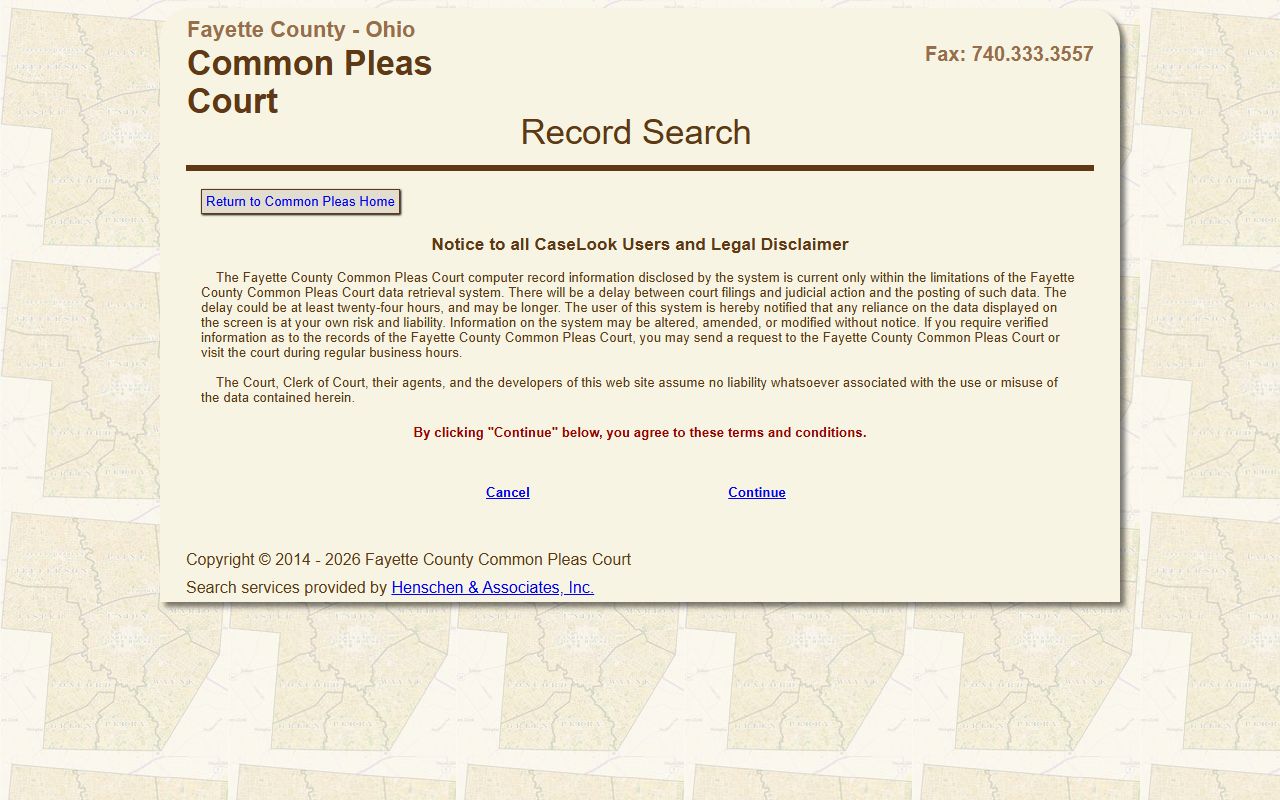
That delay means a Fayette County Jail booking can be real even when the court case is not yet visible online. It also means the online entry should not be treated as a certified record. For verified information, both CaseLook disclaimers direct users to request the record from the court or visit during regular business hours.
Automated research did not reach the final search forms past the disclaimer gates, so exact search fields should not be overstated. After continuing through the disclaimer, use the fields the portal provides, usually a name or case number search, and verify important results with the clerk before relying on them.
How to Find Fayette County Court Records After an Arrest
Start with the system that answers the first question. If the question is current custody, check the Miami Valley Jails roster or call the Fayette County Jail at 740-333-3783. If the question is the filed case, choose the court by charge level. CaseLook can be useful for a quick docket check, but certified copies, older Common Pleas records, and verified dispositions belong with the appropriate clerk.
- Confirm whether the person is still in the Fayette County Jail, especially if the arrest happened recently.
- For traffic and misdemeanor cases, check Washington Court House Municipal Court CaseLook or call the municipal clerk at 740-636-2350.
- For felony cases, check Fayette County Common Pleas CaseLook or contact the Clerk of Courts at 740-335-6371.
- If no case appears, allow for the CaseLook delay and contact the clerk before assuming the arrest did not result in a filing.
- For prior-to-2001 Common Pleas material, use the clerk's prior-record search page, which the research notes uses public login credentials.
- For the original report, booking sheet, video, or sheriff-held record, use the sheriff records process rather than a court portal.
Fayette County Sheriff's Office records requests may be made by phone at 740-335-6170, fax at 740-333-3597, email at sheriff.records@fayette-co-oh.com, or mail to 1500 Robinson Road SE, Washington C.H., OH 43160. The sheriff records page says incident and private-property crash reports can take 3 to 5 days to be completed and approved. Body camera, dash camera, or other video requests may require a $75 deposit, and anonymous video requesters must provide enough contact information for cost notices.
How Charges Get Filed After an Arrest: Complaint, Information, and Indictment
A jail arrest is not the same thing as a final court charge. Booking records can reflect arresting-agency language. The court record begins when a charging document is filed and accepted in the proper court. Fayette County research identifies three useful charging-document concepts for readers comparing a jail arrest to the court docket: complaint, information, and indictment.
| Complaint | Information | Indictment | |
|---|---|---|---|
| Filed By | Law enforcement or prosecutor, depending on the case | Prosecutor | Grand jury, presented through the prosecutor |
| Common For | Misdemeanors and initial felony matters, especially at municipal stage | Felony charging when Ohio procedure permits and indictment is waived or not required | Felony cases filed in Common Pleas after grand-jury action |
| Starts | A filed court case or early criminal proceeding | A prosecutor-filed felony case | A Common Pleas felony case or added felony charges |
| Why It Matters | May explain the first charge shown after arrest | Shows the prosecutor's selected charge path | May differ from the original booking charge after review |
Prosecutor Review After a Fayette County Arrest
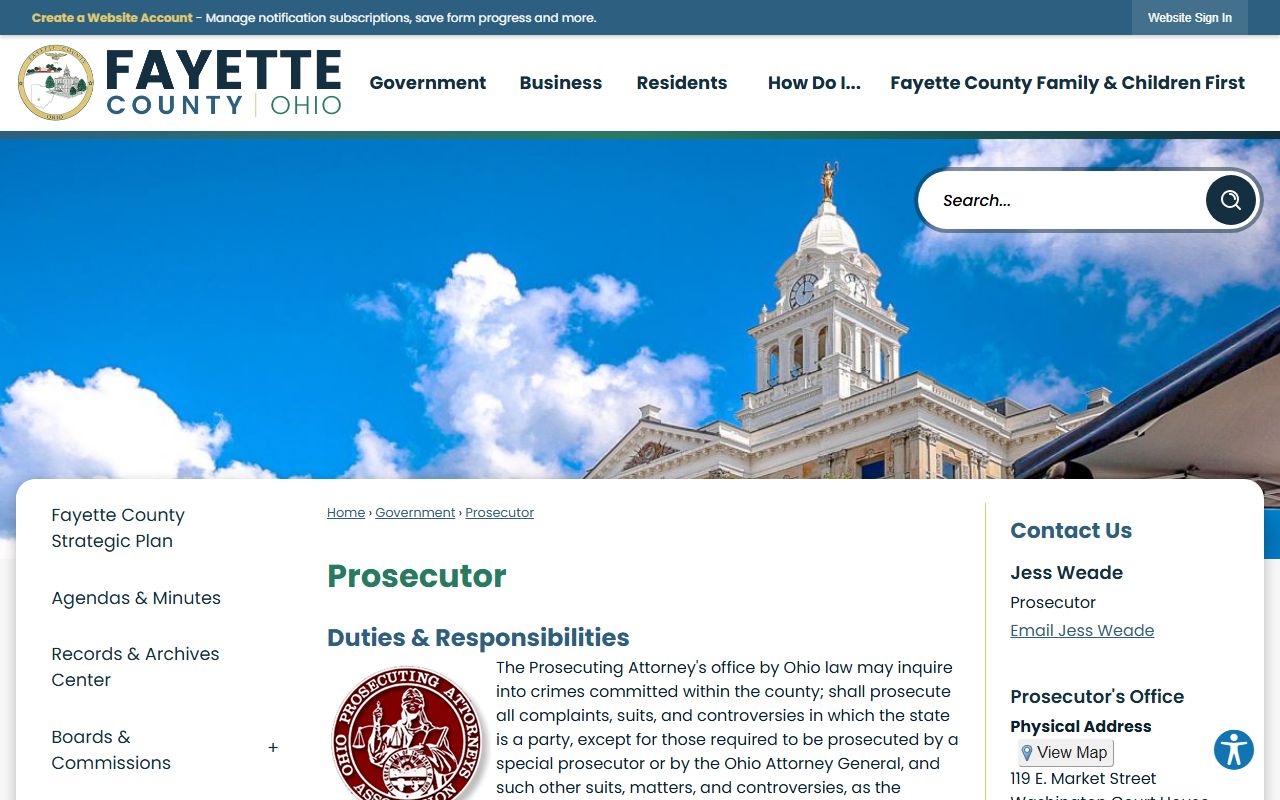
Ohio counties use prosecuting attorneys, not district attorneys. Fayette County Prosecuting Attorney Jess Weade is listed as Prosecutor from 2011 to current. The prosecutor's office is at 119 E. Market Street, Washington Court House, OH 43160, phone 740-335-0888, fax 740-333-3539, with hours Monday through Friday from 8:00 AM to 4:00 PM.
The prosecutor page says the office inquires into crimes committed within the county and prosecutes complaints, suits, and controversies where the state is a party, except matters assigned to a special prosecutor or the Ohio Attorney General. Its Criminal Division serves the Common Pleas criminal docket and handles criminal cases, extradition, bindovers from County Municipal Court, and post-conviction relief. That is why court records after a jail arrest can change: the prosecutor can file different, amended, reduced, additional, or dismissed charges after reviewing the arrest and evidence.
The Fayette County Prosecutor page lists office divisions and contact information for the office that handles many post-arrest charging decisions.
Victim Witness services also matter in post-arrest court records. The prosecutor's Victim Witness page says that office assists victims from Common Pleas, Juvenile, and Municipal Court cases, provides court-case notification, and helps with VINE notification.
Charge Status and What It Means
Charge status is the bridge between an arrest entry and the final court outcome. A charge may be pending at arraignment, changed by prosecutor review, reduced by plea agreement, dismissed by the court, or resolved by conviction after a plea or verdict. Because Fayette County CaseLook may lag by at least 24 hours, a status shown online should be checked against the clerk when timing matters.
| Status | What It Means |
|---|---|
| Pending | The charge remains open. Future hearings, bond orders, plea dates, or trial settings may still appear. |
| Amended / Reduced | The prosecutor or court record now uses a different charge, degree, or count than the first arrest wording. |
| Dismissed | The listed count was ended without a conviction on that count. Other counts or later filings may still exist. |
| Nolle Prosequi | The prosecutor has declined to continue that charge, subject to how the court records the dismissal. |
| Convicted | The case or count resulted in a guilty plea, no-contest finding where applicable, or verdict treated as a conviction. |
Bond and Warrant Context After an Arrest
Ohio bond law is in ORC Chapter 2937. Section 2937.22 describes bail as security for appearance on a criminal or quasi-criminal charge and lists forms such as cash deposit, recognizance, and surety. Section 2937.222 allows a hearing on denying bail in serious listed offenses, including murder and certain felony, violence, stalking, and OVI situations.
The Washington Court House Municipal Court traffic and bond page gives local context. It says bonds assure court appearance and directs officers to consider offense type, residence, employment, past history, and demeanor in minor-misdemeanor situations. The schedule includes examples such as $100 for an Ohio resident minor misdemeanor, $1,000 for a resident first-degree misdemeanor, and $50,000 for a resident first-degree felony. It also lists higher or special conditions for repeat DWI/OVI, domestic violence, menacing by stalking, protection-order violations, property damage while incarcerated, murder, and manslaughter. The court says it will not accept 10 percent bonds unless ordered.
| Bond Type | How It Works |
|---|---|
| Cash Bond | Money is posted as security for court appearance, if the person is otherwise eligible for release. |
| Surety Bond | A surety or bonding company backs the appearance obligation, subject to court and jail acceptance. |
| Recognizance | The person is released on a promise to appear, when the court allows it. |
| No-Bond Hold | The person is not releasable on ordinary bond until further court action or hearing. |
Always confirm current bond and hold status with the jail or court before paying. A listed bond does not release someone if another warrant, detainer, probation or parole hold, protection-order condition, or court order blocks release.
Warrants That Lead to an Arrest
Warrants can turn a court case into a jail booking. Fayette County research found warrant-related references for arrest warrants, bench warrants, probation-related warrants, failure-to-appear warrants, and warrants from other courts or agencies. Once someone is arrested on a Fayette County warrant and remains in custody, the Fayette County Jail and Miami Valley Jails roster become the custody lookup channel.
Washington Court House Municipal Court materials reference an Active Warrants List in navigation, but no functioning public warrant list was verified during research. Do not treat that as a working official public warrant search. For misdemeanor or traffic bench warrants, contact the municipal clerk at 740-636-2350 or the probation department at 740-636-2352. For felony or Common Pleas warrants, check Common Pleas CaseLook and contact the Clerk of Courts. No Fayette-specific warrant-amnesty or walk-in clearance program was located, so a person with a possible warrant should verify court requirements and consider legal counsel before appearing anywhere that could result in arrest.
Charges vs. Convictions in Court Records
A charge is an accusation filed after an arrest. A conviction is a later court result. Treating the two as the same can create serious errors, especially when a jail record shows one arrest charge and the court record later shows dismissal, amendment, reduction, or a plea to a different count.
| Charge | Conviction | |
|---|---|---|
| Stage | Filed accusation after arrest or prosecutor review | Final finding through plea, verdict, or qualifying court result |
| Meaning | Alleges conduct and begins or continues a case | Establishes guilt for that offense as recorded by the court |
| Can Change? | Yes. Charges may be amended, reduced, added, or dismissed. | Only changes through court action, appeal, sealing, expungement, or other lawful process. |
| Verification | Check the filed docket and charging document | Request the disposition or certified copy from the clerk |
Sealed vs. Expunged Arrest Records
Ohio's sealing and expungement route for eligible criminal records is addressed in ORC 2953.32. The terms are related but not identical. Sealing generally limits public access to an eligible record. Expungement, where permitted, is a stronger remedy tied to destruction, deletion, or treatment as though the record did not exist under the statute. Eligibility depends on the case result, offense, timing, prior record, and the court's decision.
| Sealed | Expunged | |
|---|---|---|
| Public Visibility | Hidden from ordinary public access after the court grants relief | Destroyed, deleted, or treated as not existing where the statute permits |
| Record Holder | Courts and agencies may retain limited controlled access | Access is narrower and depends on the exact expungement order |
| How to Pursue | File in the court where the case was handled | File in the court where the case was handled when expungement is available |
| Fayette Note | Municipal Court lists a $50 application-to-seal-or-expunge fee on its fees page | Ask the court and sheriff what remains releasable after any order |
Verified Copies and Restricted Court Records After Arrest
Use the clerk for verified copies, certified dispositions, and older records. A CaseLook screenshot is useful for orientation, but it is not the same as a certified court record. Common Pleas prior-to-2001 records have their own clerk-linked search route, and the research notes the public username and password are both listed as public on that page.
Ohio Public Records Act access is broad but not unlimited. ORC 149.43 contains exceptions for certain confidential law-enforcement investigatory records, protected personal information, restricted body-camera and dashboard-camera portions, victim images, inmate-record exceptions, and other protected material. Juvenile records, sealed records, victim-sensitive material, and ongoing investigative content may be withheld or redacted. For state-prison records, ORC 5120.21 controls ODRC inmate-record access. For Fayette court records after a jail arrest, the best rule is to ask the office that maintains the record: sheriff records for booking and reports, municipal clerk for misdemeanor and traffic court files, and the Clerk of Courts for Common Pleas files.
Background Check Considerations
Court records after arrest can be sensitive and incomplete if read without the docket context. A charge may not be a conviction, a case may be sealed, and a person's current custody may have changed after the record was posted. Do not use casual court or jail lookups as a substitute for a lawful screening process.
Important: This site is not a consumer reporting agency under the FCRA and cannot be used for employment, housing, credit, insurance, or similar eligibility decisions.